Fracture Management in Baner, Pune
Prompt clinical evaluation, precise radiologic diagnosis, cast immobilization, and advanced internal fixation for safe bone healing.
What is Fracture Management?
A fracture is a break or crack in a bone that occurs when physical force exerted on the skeleton exceeds the bone's structural strength. Fractures can range from hairline stress cracks to complex displaced or comminuted fractures.
Effective fracture management aims to restore anatomical alignment of the broken bone segments, immobilize the injury to permit cellular bone healing (callus formation), and protect surrounding nerves, muscles, and blood vessels.
Types of Fractures & Trauma Evaluated
At Rajmangal Clinic in Baner, we assess fractures across various skeletal regions:
- Closed (Simple) Fractures: Where the skin over the broken bone remains intact.
- Displaced Fractures: Where bone fragments have shifted out of their anatomical position and require reduction.
- Wrist & Forearm Fractures: Common injuries following a fall on an outstretched hand (FOOSH), such as Colles fractures.
- Ankle & Foot Fractures: Inversion twists, malleolar breaks, or metatarsal stress fractures.
- Clavicle & Shoulder Fractures: Breaks resulting from direct impacts, cycling accidents, or contact sports.
Clinical Assessment & Imaging
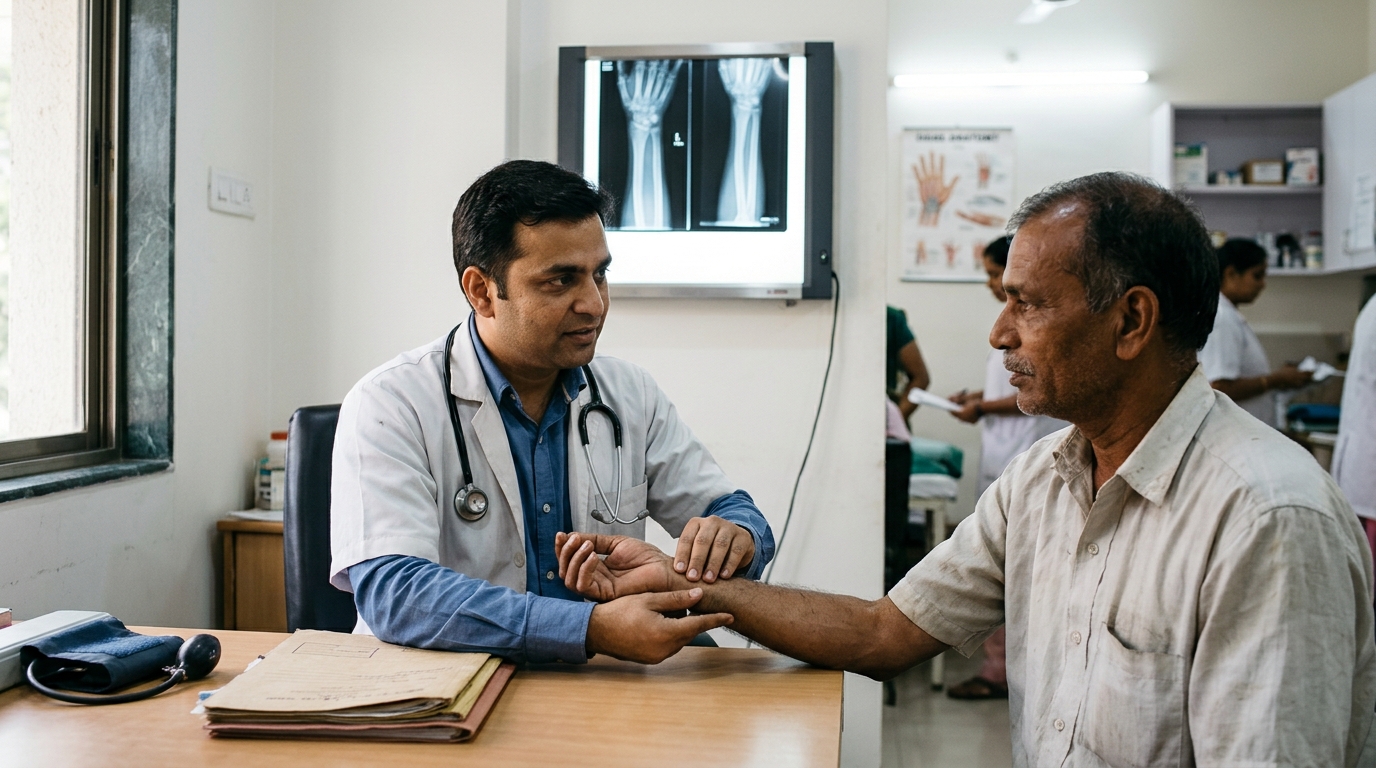
Accurate management begins with a detailed physical examination checking for tenderness, swelling, neurovascular integrity (sensation and pulses distal to the injury), and limb alignment.
High-resolution digital X-rays from multiple angles (AP and lateral views) are reviewed to inspect fracture lines, displacement degrees, and joint involvement. In complex intra-articular injuries, advanced CT scans may be recommended to plan exact reconstruction.
Treatment Approaches: Conservative vs. Surgical
Non-Surgical Management (Immobilization)
For stable, undisplaced, or well-reduced fractures, non-surgical treatment is the primary standard. This involves:
- Splinting: Temporary initial support allowing initial tissue swelling to subside safely.
- Fiberglass / Plaster Casting: Rigid circumferential immobilization maintaining bone alignment throughout healing.
- Removable Braces: Functional bracing allowing early joint motion where clinically safe.
Surgical Treatment (When Indicated)
Certain fractures require surgical stabilization (Open Reduction and Internal Fixation - ORIF) when fragments are severely displaced, unstable, or involve joint surfaces. Surgical options include anatomical plates, screws, or intramedullary rods to secure the bones securely, facilitating earlier mobility.
The Fracture Care Pathway
Recovery, Healing & Rehabilitation
Most fractures require 6 to 12 weeks for substantial clinical and radiologic union. Following cast removal or surgical recovery, progressive physical therapy helps rebuild joint mobility, muscle strength, and proprioceptive balance.
Your Treating Specialist

Dr. Anand Surana
Fellowship-trained in joint replacement and trauma surgery with international training from PEOC Exeter, UK.
Frequently Asked Questions
How long does a bone take to heal?
Depending on age, nutrition, fracture site, and blood supply, most adult fractures take between 6 to 10 weeks to unite. Follow-up x-rays verify healing progress before cast removal.
Can a displaced fracture be treated without surgery?
Some displaced fractures can be realigned using closed reduction (manual manipulation under anesthesia) and held with a cast. However, if the alignment cannot be maintained securely, surgery may be recommended.
Fracture Consultation in Baner, Pune
For fracture follow-ups, cast checks, or recent bone trauma assessments, visit Rajmangal Clinic on Baner Road opposite Primrose Mall.
Consultation Request
Thank You
Our team will contact you to confirm your consultation schedule.